sat suite question viewer
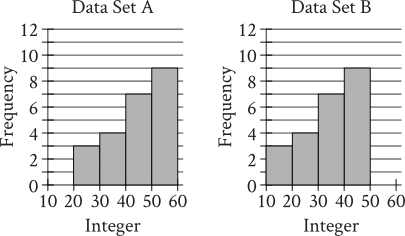
Two data sets of integers each are summarized in the histograms shown. For each of the histograms, the first interval represents the frequency of integers greater than or equal to , but less than . The second interval represents the frequency of integers greater than or equal to , but less than , and so on. What is the smallest possible difference between the mean of data set A and the mean of data set B?
Explanation
Choice B is correct. The histograms shown have the same shape, but data set A contains values between and and data set B contains values between and . Thus, the mean of data set A is greater than the mean of data set B. Therefore, the smallest possible difference between the mean of data set A and the mean of data set B is the difference between the smallest possible mean of data set A and the greatest possible mean of data set B. In data set A, since there are integers in the interval greater than or equal to but less than , integers greater than or equal to but less than , integers greater than or equal to but less than , and integers greater than or equal to but less than , the smallest possible mean for data set A is . In data set B, since there are integers greater than or equal to but less than , integers greater than or equal to but less than , integers greater than or equal to but less than , and integers greater than or equal to but less than , the largest possible mean for data set B is . Therefore, the smallest possible difference between the mean of data set A and the mean of data set B is , which is equivalent to . This expression can be rewritten as , or , which is equal to . Therefore, the smallest possible difference between the mean of data set A and the mean of data set B is .
Choice A is incorrect. This is the smallest possible difference between the ranges, not the means, of the data sets.
Choice C is incorrect. This is the difference between the greatest possible mean, not the smallest possible mean, of data set A and the greatest possible mean of data set B.
Choice D is incorrect. This is the smallest possible difference between the sum of the values in data set A and the sum of the values in data set B, not the smallest possible difference between the means.