sat suite question viewer
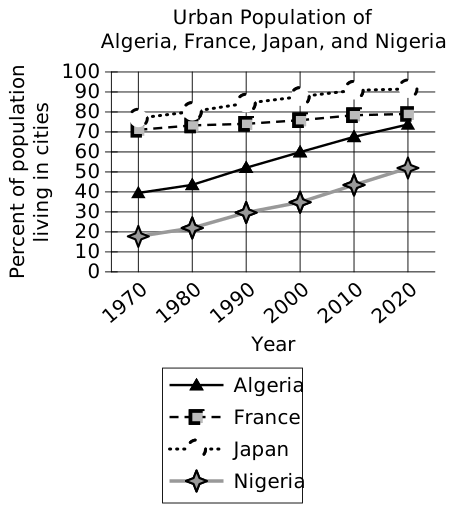
- The following 4 lines are shown:
- Algeria
- France
- Japan
- Nigeria
- The Algeria line:
- Begins at 1970, 39.5 percent
- Rises gradually to 1980, 43.54 percent
- Rises sharply to 1990, 52.09 percent
- Rises gradually to 2000, 59.92 percent
- Rises gradually to 2010, 67.54 percent
- Rises gradually to 2020, 73.73 percent
- The France line:
- Begins at 1970, 71.06 percent
- Rises gradually to 1980, 73.28 percent
- Rises gradually to 1990, 74.06 percent
- Rises gradually to 2000, 75.87 percent
- Rises gradually to 2010, 78.37 percent
- Rises gradually to 2020, 79 percent
- The Japan line:
- Begins at 1970, 76.88 percent
- Rises gradually to 1980, 80.17 percent
- Rises gradually to 1990, 84.34 percent
- Rises gradually to 2000, 87.65 percent
- Rises gradually to 2010, 90.81 percent
- Rises gradually to 2020, 91.5 percent
- The Nigeria line:
- Begins at 1970, 17.76 percent
- Rises gradually to 1980, 21.97 percent
- Rises gradually to 1990, 29.68 percent
- Rises gradually to 2000, 34.84 percent
- Rises sharply to 2010, 43.48 percent
- Rises sharply to 2020, 51.96 percent
The share of the world’s population living in cities has increased dramatically since 1970, but this change has not been uniform. France and Japan, for example, were already heavily urbanized in 1970, with 70% or more of the population living in cities. The main contributors to the world’s urbanization since 1970 have been countries like Algeria, whose population went from blank
Which choice most effectively uses data from the graph to complete the assertion?
Explanation
Choice D is the best answer. This choice effectively uses data from the graph to complete the example. The line representing the percent of Algeria’s population living in cities is the black triangle line. According to the graph, it started at 40% in 1970 and reached 70% in 2020.
Choice A is incorrect. This choice misreads the graph. The line representing the percent of Algeria’s population living in cities is the black triangle line. According to the graph, it started at 40% in 1970 and reached 70% in 2020. Choice B is incorrect. This choice misreads the graph. The line representing the percent of Algeria’s population living in cities is the black triangle line. According to the graph, it started at 40% in 1970 and reached 70% in 2020. Choice C is incorrect. This choice misreads the graph. The line representing the percent of Algeria’s population living in cities is the black triangle line. According to the graph, it started at 40% in 1970 and reached 70% in 2020.